Pre-owned Ultrasound Probes & Transducers

All ultrasound probes and transducers listed are professionally reconditioned and fully tested to ensure reliable performance. New ultrasound probes are also available—please call 888-761-0358 for availability and pricing.
We offer a comprehensive selection of internal and external ultrasound probes and transducers compatible with leading ultrasound systems from top manufacturers, including Acuson, ATL, Diasonics, Eden, GE, HP, Kretz, Medison, Philips, and Shimadzu. Buying re-owned ultrasound probes provides a cost-effective alternative to new equipment while maintaining image quality and clinical accuracy.
Our inventory includes internal ultrasound probes for transvaginal, transrectal, and transesophageal imaging, as well as external probes for general and specialty use. Supported imaging modalities include Doppler ultrasound, echocardiography, bone sonography, and imaging formats in 2D, 3D, and 4D.
Browse our selection of re-owned ultrasound probes and transducers to find compatible, high-quality options for your imaging system. Our team is available to help with compatibility questions and product selection.
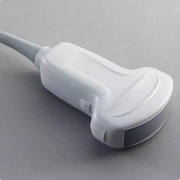
Pre-owned Ultrasound Probes & Transducers Questions & Answers
First, there is the cardiac transducer, whose primary use is echocardiography. In some cases, because the frequency is low, it can used for abdominal studies as well.
Second, there is a vascular transducer, which is typically used for carotid arteries and veins, including those in the legs. It can also be used for the thyroid, needle-guided injections, and in some cases, when the frequency is high enough, for breast exams, as well. It is important to note that when using it for breast exams, it should not take the place of conventional mammography, but rather in conjunction with it.
Third, abdominal transducers are used in organs, such as kidney, liver, spleen, and stomach. Typically ob/gyn studies are performed with abdominal transducers.
Fourth, transvaginal transducers are used to perform studies on women at various stages of pregnancy, during every ultrasound..
Fifth, there is the endorectal transducer, which is typically used to check for rectal cancer. Urologists primarily use this transducer.
Last, the transesophageal echocardiography (TEE) transducer is used to evaluate cardiac studies by use of the echo transducer that produces the sound waves for TEE. The probe is attached to a thin tube that passes through your mouth, down your throat and into your esophagus. Because the esophagus is so close to the upper chambers of the heart, very clear images of those heart structures and valves can be obtained.
An ultrasound transducer is a wand-like instrument that gives off sound waves and picks up the echoes as they bounce off the organs. It is a device, usually electrical, or, in some cases, mechanical, that converts one type of energy to another. A transducer, or probe, is the main part of the ultrasound machine. The transducer sends ultrasound waves into the body and receives the echoes produced by the waves when it is placed on or over the body part being imaged.
The key difference between 2D and 3D echocardiography is that 2D provides “flat” views of the heart, while 3D/4D is based on real time volumetric imaging providing a realistic anatomic display from virtually any desired perspective. 2D transducers are arranged in a 1D array, which can acquire cross-sectional 2D images using piezoelectric elements (ceramics or single crystals). The most widely available type of 3D transducer is the mechanical transducer, which is low-cost and achieves state-of-the-art image quality, although it cannot produce images in real time. 4D transducers are matrix array transducers, which generate an ultrasound pulse diverging from the array in a pyramid shape and produce high-quality images in real time. This technology is used in obstetrics only for the evaluation of the fetal heart and adult echocardiography.
The old style mechanical transducers were set and designed at a certain frequency. Multiple transducers had to be purchased for different depths of studies. Modern state of the art transducers are designed to be capable of varying the frequency, depending on the depth necessary for a given ultrasound.
No, they work strictly by giving off sound waves.
Mechanical transducers have a motor inside. They are usually older and slower, and have a shorter life expectancy. Typically, 3D/4D transducers are mechanical and have a much larger footprint. Electrical transducers are faster, smaller, and last longer.
The shape of the probe determines its field of view. Cardiac is typically the smallest; vascular ranges in size from 25mm to 50mm; abdominal/curved shape has a larger footprint, and transvaginal transducers are long and skinny with a small head.
Modern day transducers are made of crystals which typically can last for 10-plus years. Transducers do lose quality when elements and crystals have been damaged. It is covered by a rubber array/lens, which can be worn away by over-zealous sterilization procedures and must be replaced or repaired. Usually this repair runs between $750 to $1000.
Mechanical transducers have a much shorter life expectancy and depending on the frequency of use can usually last 3 to 5 years before needing replacement.