The
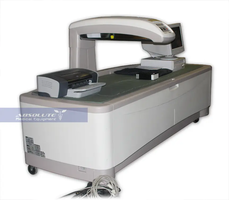
GE Lunar Prodigy Advance offers top-quality DXA (dual energy X-ray
absorptiometry) assessment with exceptional precision and keeps
radiation at a dose lower than average in the field of bone
densitometers. The Lunar Advance also helps you streamline your office's
patient records, keeping all necessary patient files as easy to access
as possible.
Our Lunar Prodigy Advance utilizes a direct-digital
array detector and narrow-angle fan-beam technology to enhance dose
efficiency and achieve excellent precision and patient throughput in
spine (10sec), femur (10sec) and total body measurements.
- Model Year 1999
- Tube Year - 2002
Precise technology at quality prices.
Absolute Medical offers a 60-day warranty with the purchase of our GE Lunar Advance Bone Densitometer.
Expert delivery, training, calibration, and service available for $2,500.
High-Precision DXA for Bone Density and Body Composition
The GE Lunar Prodigy Advance Bone Densitometer is a dual-energy X-ray (DXA) system designed for
fast, precise assessment of bone mineral density (BMD) and body composition. Using a
narrow-angle fan beam and direct-digital detector, it delivers highly accurate measurements at major skeletal sites
while keeping radiation dose low and exam times short.
Prodigy Advance supports a wide range of clinical applications including AP spine, femur, DualFemur, forearm,
total body BMD, vertebral fracture assessment (VFA), pediatric studies, and regional body composition.
Workflow tools such as QuickView screening, Previous Scan Image comparison, and automatic metal detection help
streamline exams and support consistent, reproducible results in busy osteoporosis and metabolic health practices.
GE Lunar Prodigy Advance Bone Densitometer Specifications:
| Technology |
Dual-energy X-ray absorptiometry (DXA) with narrow-angle fan beam and direct-digital detector |
| Clinical Applications |
AP spine, femur, DualFemur, forearm, total body BMD, vertebral fracture assessment, pediatric spine/total body/femur,
and total & regional body composition (fat, lean, %fat) |
| Workflow & Analysis Features |
QuickView screening, OneScan/OneVision tools, Previous Scan Image comparison, automatic metal detection,
custom regions of interest, automated reporting, and practice management tools |
| Connectivity & Data Management |
DICOM image and report export, HL7 interface, database server support, multi-user access, and report sharing |
| Scanner Dimensions |
Approx. 262 × 109 × 128 cm (103" × 43" × 51") |
| Active Scan Area |
Approx. 197.5 × 60.0 cm |
| Patient Table & Capacity |
Low-height patient table with washable mat; maximum patient weight approx. 159 kg (350 lb) |
| Power Requirements |
100–120 VAC or 230–240 VAC, 50/60 Hz, dedicated circuit; typical power consumption up to ~450 VA during scanning |
| Environmental Conditions |
Operating temperature typically 18–27 °C (65–81 °F); humidity 20–80% non-condensing |
| Typical Applications |
Osteoporosis diagnosis and follow-up, fracture risk assessment, vertebral assessment, pediatric bone health,
and whole-body/segmental body composition analysis in metabolic health, obesity, and sports medicine |
2024_Body_Composition_Brochure_JB48048XX.pdf