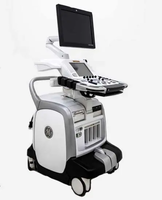
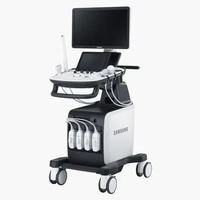
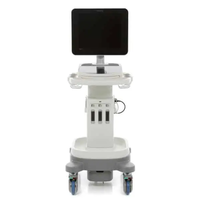
The Philips Affiniti 30 ultrasound machine combines everyday diagnostic imaging with tools designed to make a busy examination schedule easier to manage. Its cart-based design brings image acquisition, measurements, review, and reporting into one workstation, making it a practical choice for clinics that need to move between routine examinations and more specialized studies.
Philips developed Affiniti 30 around precision beamforming and Tissue Specific Presets. These technologies help balance tissue detail, contrast, and image uniformity while reducing the adjustments needed to begin an examination. In women's health configurations, the platform supports obstetric and gynecological imaging, with volume imaging and tissue assessment options available for practices that need more than conventional 2D scanning.
Key Features
- Precision beamforming: processes ultrasound signals to support spatial and contrast resolution, with attention to tissue uniformity and reduced image clutter.
- Tissue Specific Presets: configure imaging parameters for the selected transducer and examination, giving the operator a useful starting point for each study.
- Automated image optimization: real-time iSCAN/AutoSCAN can adjust gain and time-gain compensation during scanning, depending on the installed software.
- Guided examinations: SmartExam protocols can organize required views, annotations, and examination steps to support a consistent scanning sequence.
- Women's health options: compatible volume probes and licensed software enable 3D/4D acquisition and surface rendering for fetal and gynecological imaging.
- Additional analysis options: strain elastography, iSlice volume viewing, and QLAB GI 3DQ are described in Philips documentation; availability must be confirmed for the offered unit.
- Operator comfort: a 21.5-inch main monitor, touchscreen controls, adjustable console, and cable management help organize the scanning workspace.
- Connected workflow: DICOM functions support sharing images, measurements, and reports with compatible clinical systems when appropriately configured.
Clinical Applications
Depending on the selected probes and application packages, Affiniti 30 can support abdominal and general imaging, small-parts and breast studies, vascular examinations, and obstetric/gynecological scanning. For an OB/GYN practice, this can include early pregnancy assessment, fetal anatomy examinations, and pelvic imaging. A suitable probe and the required application license are essential for each intended examination.
Philips Affiniti 30 Specifications
| System type | Cart-based diagnostic ultrasound workstation |
|---|
| Image formation | Precision beamforming with Tissue Specific Presets |
|---|
| Primary display | 21.5-inch (54.6 cm) monitor |
|---|
| Operator interface | Touchscreen plus console controls; adjustable working position |
|---|
| System width | 57.2 cm (approximately 22.5 in) |
|---|
| System depth | 98.3 cm (approximately 38.7 in) |
|---|
| System height | 142.2–162.6 cm (approximately 56–64 in), depending on adjustment |
|---|
| System weight | Approximately 83.6 kg (184 lb); installed accessories affect total weight |
|---|
| Volume imaging | Optional 3D/4D acquisition and analysis with compatible probes/software |
|---|
| Example compatible probes | C6-2, C9-4v, L12-5, V6-2, and 3D9-3v, subject to configuration |
|---|
| Data management | DICOM imaging/reporting functions; network and wireless options vary |
|---|
| Service design | Modular architecture and on-cart maintenance tools |
|---|
Choosing Your Configuration
Before ordering, ask Absolute Medical to identify the included transducers, installed software release, enabled examination packages, and available connectivity. If your work requires 3D/4D, elastography, or a specific reporting workflow, have those functions confirmed on the quoted system. A manufacturer brochure describes the platform and its available options; it does not establish which accessories or licenses accompany an individual pre-owned machine. Request details of the offered unit's condition, warranty, and delivery arrangements with your quotation.
For practices replacing an existing scanner, compare the proposed probe set against the examinations you currently perform. Also identify how images and reports will reach your reading workstation. These details make the quotation more useful than a comparison based only on the model name or headline system price.
Manufacturer Brochures