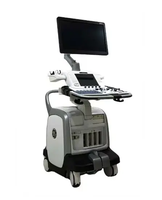
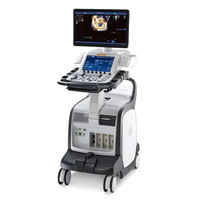
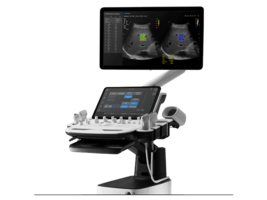
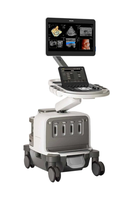
The Philips ClearVue 550 is a shared-service ultrasound system designed for practices that need a versatile cart-based platform for daily diagnostic examinations. Its compact design, straightforward controls, and modular architecture suit clinics that want a practical workstation for several examination types without dedicating a separate system to every specialty.
At the center of ClearVue is Philips Active Array technology, paired with broadband beamforming. The platform supports a selection of probes and imaging functions for routine scanning, while the operator can choose the application and settings appropriate to the patient. Philips positions the 550 within the ClearVue family for busy scanning environments; the specific capabilities of a pre-owned unit depend on its software, probes, and enabled options.
Key Features
- Active Array imaging platform: Philips transducer and system technology designed to support diagnostic image quality across a range of examinations.
- Broadband beamforming: processes returning ultrasound information to help distinguish tissue structures across different patient and examination types.
- Image enhancement: SonoCT compound imaging, XRES processing, and harmonic imaging are described in the ClearVue family documentation; confirm their availability on the offered 550.
- Image optimization: iSCAN and AutoSCAN workflow functions help with image adjustment, with availability dependent on system generation and installed software.
- Shared-service flexibility: compatible transducers allow a practice to configure the system around its actual general imaging, women's health, vascular, or cardiac workload.
- Compact mobile format: a wheeled console makes it easier to position the system in an examination room or move it between clinical areas.
- Modular construction: Philips designed the ClearVue platform with serviceability and future configuration changes in mind.
- Examination documentation: DICOM services can connect supported configurations to compatible image storage, worklist, printing, and reporting workflows.
Clinical Applications
The ClearVue family covers abdominal imaging, obstetrics and gynecology, vascular studies, musculoskeletal examinations, small parts, and cardiac imaging. Choose a curved-array probe for appropriate abdominal or obstetric work, a linear probe for suitable superficial or vascular examinations, and an application-compatible sector probe for cardiac studies. Probe compatibility, software support, and included examination packages should be checked together when selecting a unit.
Philips ClearVue 550 Specifications and Capabilities
| System type | Compact cart-based shared-service diagnostic ultrasound |
|---|
| Core technology | Philips Active Array platform |
|---|
| Signal processing | Broadband beamforming |
|---|
| Imaging | 2D imaging and Doppler capabilities according to installed configuration |
|---|
| Image enhancement options | SonoCT, XRES, and harmonic imaging; verify installed functions |
|---|
| Workflow tools | iSCAN/AutoSCAN availability depends on software and configuration |
|---|
| Transducer selection | Application-compatible curved, linear, endocavitary, and sector probes |
|---|
| Display and controls | Console-mounted monitor and operator control panel; hardware varies by generation |
|---|
| Volume imaging | Selected ClearVue 550 generations are upgradeable to 4D; requires compatible hardware, probes, and software |
|---|
| Network integration | DICOM capabilities vary by software release and installed options |
|---|
| Data workflow | Supported releases provide image storage, worklist, and structured-report functions |
|---|
| Construction | Mobile cart with a modular system design |
|---|
Selecting a Pre-Owned ClearVue 550
Ask Absolute Medical for the exact probe list, software version, and enabled applications before purchase. Philips' family brochures also describe the ClearVue 350, 650, and 850, so features shown elsewhere in those brochures should not automatically be assumed to be included on a 550. If you need volume imaging, a particular Doppler function, or PACS integration, request confirmation for the actual unit being quoted.
For a useful quotation, describe your examination mix and any existing transducers or network requirements. Have the included accessories, condition, warranty terms, and delivery arrangements recorded with the proposed configuration so you can compare the complete system against your practice's needs.
Manufacturer Brochures